
Reference Relevance and Evidence Roles
A footwear reference becomes useful when the review question is visible.
A folder of product screenshots, material close-ups, campaign images, and trend pages can leave a team discussing different decisions at once. One person sees the silhouette; another sees the finish; a third assumes the image also supports comfort, feasibility, or reuse permission.
Good design reference selection separates those roles. Each image should answer a defined question, show an observable cue, and carry a source record that makes its status reviewable.
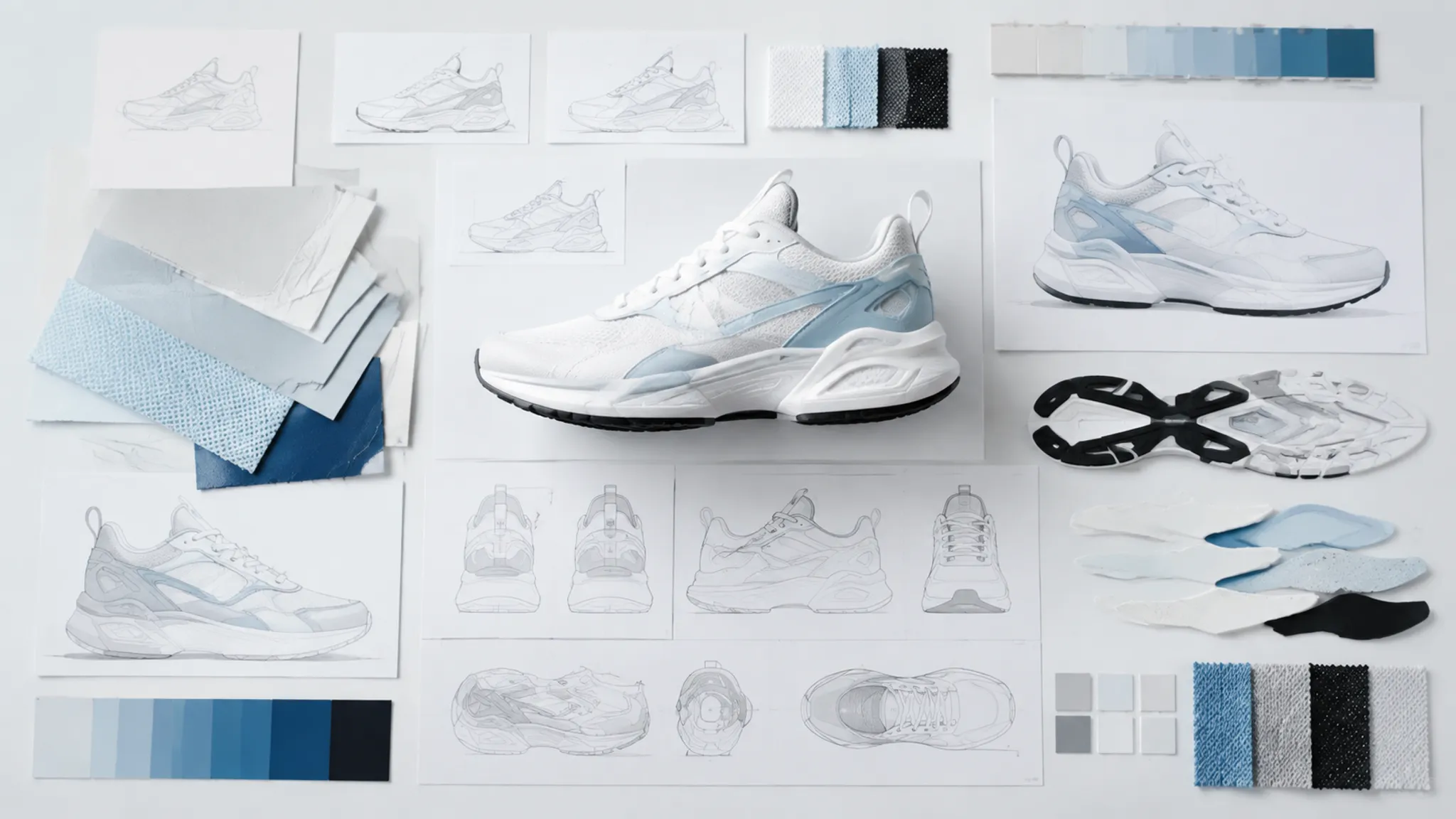
Start With the Decision
Name the decision before collecting references.
A footwear team may need to compare a low, streamlined silhouette with a fuller everyday trainer; a technical upper with visible zoning against a simpler construction; a tonal material story against a high-contrast colorway; or one coherent model family against several distinct variants. A campaign-facing concept render and a development reference may also describe the same shoe differently because they serve different review purposes.
A board that tries to answer all of these questions at once usually becomes crowded and difficult to interpret. A stronger opening brief identifies three things:
- What must change: silhouette, upper zoning, material response, color relationship, view coverage, or variant logic.
- What will be compared: two or more directions that differ on that variable.
- What remains outside the review: fit, comfort, performance, manufacturing, rights, or another question requiring separate evidence.
The image then has a job. It is present because it helps a reviewer inspect a decision, not only because it looks relevant.
Give Every Reference a Role
A useful reference record can include:
| Field | What to record |
|---|---|
| Decision role | Silhouette, upper zoning, material, finish, color, context, view, or variant |
| Observable cue | The line, proportion, surface, contrast, or framing being examined |
| Interpretation | What the cue may communicate during concept review |
| Limitation | What the image cannot establish |
| Source | Original URL, publisher or author, and asset identity |
| Date | Publication or access date, when known |
| Rights status | License, permission, unknown, or unresolved |
| Review stage | Brief, concept, design, engineering, sampling, factory, or wear testing |
This structure keeps visual intention separate from factual proof. It also gives the next reviewer enough context to challenge or retain the reference.
Build a Footwear Reference Taxonomy
Organize visual references by the decision they support. The taxonomy does not need to classify every image perfectly; it needs to prevent unrelated observations from becoming one visual argument.
Silhouette References
Silhouette reference selection concerns the shoe's outer read.
A side view may show toe length, heel height, sole volume, collar position, topline movement, or the relationship between upper and outsole. A three-quarter view adds depth, but perspective and lighting can obscure the lateral profile.
Use silhouette references to compare overall massing, toe and heel proportion, sole thickness, collar shape, visual stance, and the difference between a narrow, elongated, rounded, or squared read.
Compare alternatives by visible deltas. One direction may carry a longer toe and thinner-looking sole, while another uses a shorter forepart and more prominent base. That gives the review a concrete question without treating either image as evidence of fit, support, or use performance.
Upper Zoning References
Upper zoning references isolate how panels, overlays, openings, seams, and branding areas are distributed.
The useful cue may be a sweeping side overlay, layered toe structure, open quarter, cage-like visual, or continuous surface with limited interruption. Record the zone being borrowed: toe box, vamp, quarter, eyestay, heel counter area, tongue, collar, lateral or medial overlay, or logo placement.
A visible panel suggests a construction intention, but a finished product image does not establish the underlying pattern, assembly sequence, reinforcement, or manufacturing method. Keep those questions open for design and engineering review.
Material Response References
Material response references describe how a surface appears under light and beside adjacent materials.
Look for smooth or textured grain, soft or crisp edge behavior, matte or reflective response, opaque or translucent appearance, dense or open visual structure, and uniform or irregular surface character.
A close-up can support a surface direction. It cannot establish composition, durability, breathability, environmental outcome, or suitability for a particular use. Keep a material name provisional unless it is documented. Terms such as “recycled,” “bio-based,” or “technical” may carry claims that the image does not verify.
A more useful record pairs the visible cue with a follow-up: “matte, fine-grain surface direction; confirm material specification separately.”
Finish Specification References
Finish references answer a narrower question than material references.
Two surfaces may appear to use the same base material while communicating different directions through coating, brushing, embossing, washing, gloss, or edge treatment. Compare them with consistent lighting and framing.
- Matte against gloss
- Clean against weathered
- Uniform against tonal variation
- Sharp edge definition against softened edges
- High-contrast texture against restrained texture
The render shows surface appearance under chosen conditions. It does not establish how the finish will behave after production, handling, cleaning, or wear.
Color Relationship References
Color references should explain relationships rather than list attractive swatches.
A useful colorway board identifies dominant, secondary, and accent colors; warm and cool relationships; tonal transitions; contrast between upper zones and sole; continuity across a collection; and the location and proportion of a statement accent.
Market language may call a direction earthy, neutral, retro, tonal, or statement-led. Translate that language into visible instructions: which panels carry the darker value, where the accent appears, and whether the outsole separates from or merges with the upper.
A color reference supports a color relationship. It does not establish demand, market dominance, or commercial success.
View Coverage References
View coverage controls what the reviewer can inspect.
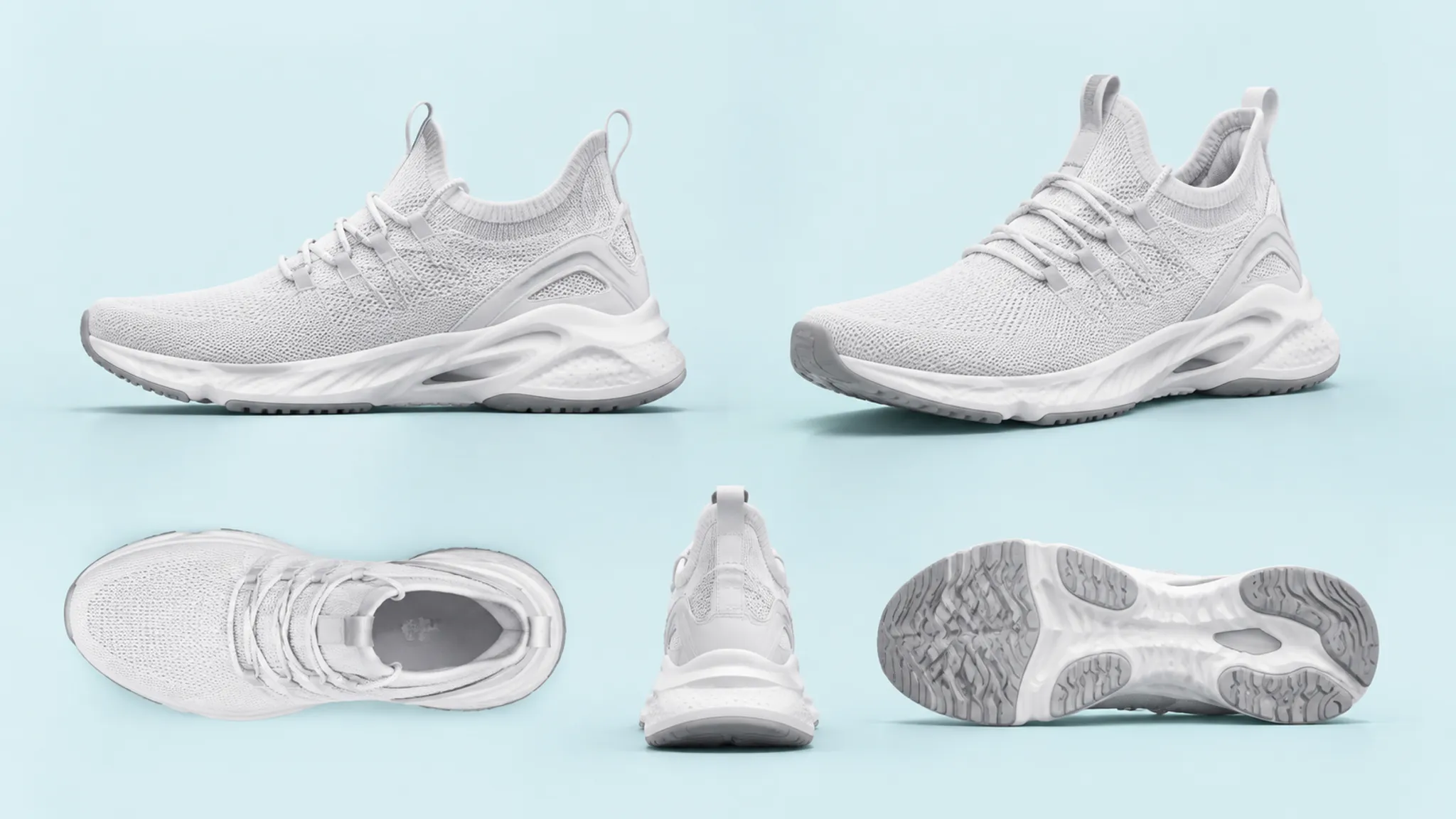
A single hero angle may work for campaign mood while obscuring the medial side, heel, outsole connection, or upper zoning. Choose views according to the decision:
- Side view: silhouette and panel flow
- Three-quarter view: volume and depth
- Top view: opening, toe shape, and color distribution
- Heel view: rear proportion and collar continuity
- Outsole view: visible tread language, without inferring traction or performance
- Turntable sequence: consistency across angles
A non-final turntable can expose inconsistencies between frames. It remains a visual communication asset, not a substitute for physical inspection.
Variant Logic References
Variant logic references help a team understand how multiple colorways or model variations belong together.
Record what stays fixed and what changes:
- Shared silhouette, changed color
- Shared upper zoning, changed material
- Shared base, changed accent
- Shared family, changed sole or collar treatment
- Separate concepts grouped only by campaign theme
For concept work, internal consistency matters more than the number of variants. A product listing or press release may provide vocabulary for named variants, but current product facts need primary verification before publication.
Separate Aspirational and Feasibility-Minded References
Do not let inspiration carry an unspoken production claim.
Aspirational references establish atmosphere, proportion, narrative, or visual ambition. They may come from architecture, fashion imagery, objects, campaign photography, or existing footwear. Their role is to widen the direction or clarify a desired mood.
Feasibility-minded references are narrower. They support a conversation about visible construction intent, material placement, component relationships, or information needed for a later handoff. The distinction is a change in review purpose, not a ranking.
| Reference type | Useful question | What remains unresolved |
|---|---|---|
| Aspirational | What should the concept look or feel like? | Whether the direction can be built or tested |
| Construction-oriented | Which visible zones or relationships should be explored? | Exact pattern, assembly, and material behavior |
| Material-oriented | What surface response should the render communicate? | Composition, sourcing, durability, and production behavior |
| Comparison-oriented | Which visible direction fits the brief more clearly? | Physical product outcomes |
| Campaign-oriented | How should the concept be framed for a viewer? | Development accuracy and product validation |
A render may carry construction intent. It cannot establish manufacturability or production readiness. Those questions move through design, engineering, sampling, factory review, and appropriate testing.
Use Hierarchy to Prevent Mixed Messages
A board needs structure before it needs volume.
Hierarchy, grouping, whitespace, and separation help reviewers identify the main direction without treating every image as equally important. A clear board may contain one primary concept render, a small silhouette group, a separate upper-zoning group, material and finish studies, a color relationship strip, and context images placed apart from construction references.
Keep the source and rights record adjacent to the working package without making it part of the visual argument. If a campaign image sits beside a close-up of a panel seam, the reviewer may assume both support the same conclusion. Group them by role instead: one establishes framing, the other supports upper zoning.
Fewer images can produce a clearer decision when each image has a named function.
Compare by Visible Deltas
Taste becomes useful in review only after it becomes observable.
When two directions are unsettled, compare them across the same variables:
| Variable | Direction A may show | Direction B may show |
|---|---|---|
| Silhouette read | Longer, lower, more tapered | Fuller, higher, more grounded |
| Upper zoning | Fewer broad panels | More layered overlays |
| Material response | Quiet matte surfaces | Contrasting reflective and textured areas |
| Color relationship | Tonal continuity | Concentrated statement accent |
| View coverage | Strong side read | More information from three-quarter views |
| Variant logic | One base with color changes | Several visible construction changes |
These are review prompts, not scores. Ask what each direction makes easier to see and what it hides. A high-contrast upper may clarify zoning while overpowering the silhouette. A tonal treatment may preserve the form read while making panel boundaries less visible. A dramatic three-quarter angle may communicate volume while obscuring the lateral profile.
The useful comparison is decision-specific. It does not declare one direction universally better.

Interpret References Without Overreading Them
A reference image becomes a design prompt through a sequence of observation, translation, comparison, and limitation.
- Observe: the reference shows a narrow side profile and low visual stance.
- Translate: explore a similarly restrained silhouette read in the concept render.
- Compare: place the alternative beside a fuller profile using the same view.
- Limit: leave fit, support, comfort, and physical performance for later evidence.
This prevents a common category error: the target shoe is not assumed to possess every property associated with the reference product.
Competitor samples and existing-shoe images can help non-designers discuss a direction across roles. A bounded practitioner account describes sketches, technical drawings, competitor samples, and existing-shoe images used for communication with sales and other non-designers. That supports a narrow workflow observation, not a universal footwear process or validation of the referenced product.
Record Source and Rights Status Early
A visually relevant image is not automatically reusable.
For each source, preserve the original URL, publisher or author, asset identity, publication or access date when known, assigned role, license or permission information, unresolved rights questions, and any planned crop, alteration, or derivative use.
Discovery pages can help locate references, but they may detach images from original context or omit reliable attribution. Public availability and attribution are not permission. Copyright guidance can help a team organize provenance and identify questions for further review, but it does not determine the status of a particular footwear image or establish reuse permission for a specific project.
Use neutral status labels:
- Permission documented
- License identified
- Source identified, rights unresolved
- Discovery lead only
- Do not reuse until reviewed
Keep this record with the board. An unattributed discovery image may remain a private lead, but it should not silently become a presentation or campaign asset.

Match the Reference to the Review Stage
The same image can serve different purposes at different stages, but its role should be renamed.
Brief Review
References clarify the intended visual territory. Mood, silhouette language, color relationships, and context can carry more weight than precise construction detail.
Acceptance question: Can the team describe the direction in visible terms?
Concept Review
Separate alternatives and identify the cue each concept borrows. Comparison views, silhouette studies, upper-zoning references, and material studies become more useful.
Acceptance question: Can reviewers identify what changes between directions?
Design Review
References need tighter correspondence with the proposed upper, sole relationship, colorway, and view coverage. List unresolved construction questions instead of hiding them inside a polished render.
Acceptance question: Does the visual package communicate the intended design decisions clearly enough for the next handoff?
Engineering and Sampling Handoff
Reference material can clarify intent, but it does not replace technical documentation, sample review, or physical inspection. Identify which questions require pattern development, material confirmation, component review, factory input, or sampling.
Acceptance question: Which visual decisions are being transferred, and which still need technical resolution?
Wear Testing or Other Validation
Physical outcomes belong to an appropriate validation process. A render cannot establish comfort, fit, cushioning, support, durability, safety, or athletic performance.
Acceptance question: What evidence is required beyond the visual package?
Choose the Review Path
When the Direction Is Ambiguous
Start with two or three distinct concept clusters. Give each a short description based on visible form, material, color, and framing, then compare the clusters using the same criteria.
Do not combine them into one inspiration board before the team has identified the difference.
When the Output Misses the Brief
Return to the assigned role of each reference. Check whether a campaign image is being used to specify silhouette, or whether a material close-up is being treated as a color direction.
Ask which visible cue was actually transferred.
When the Handoff Is Approaching
Separate decided elements from unresolved elements. A source may support the color relationship while leaving material composition unresolved; a side view may support the silhouette read while leaving fit and construction open.
Write those states beside the relevant visual group.
When Rights Control Progress
Pause reuse and inspect the source record. An unattributed discovery image can remain a lead, but it should not move into a public-facing deliverable without further review or replacement.
Common Mix-Ups
One Image Is Asked to Prove Everything
A product photograph may show silhouette, upper arrangement, colorway, and campaign context. It still does not establish that a new concept shares the product's physical or commercial properties.
Assign the image only the roles it can visibly support.
Material Vocabulary Becomes Material Evidence
A label such as “bio-based,” “recycled,” or “technical” may describe market language rather than documented composition or outcome. Keep the phrase as a prompt for specification review.
Trend Vocabulary Becomes Market Evidence
Terms such as retro revival, molded sandal, or luxury-trainer crossover can help teams search and discuss directions. They do not establish demand or commercial success.
Translate the term into a visible comparison, then verify any market claim separately.
A Polished Render Becomes a Product Decision
Lighting, camera angle, and surface treatment can make a concept appear resolved. The image may be ready for concept review while remaining open on pattern, material, engineering, sampling, factory, and testing questions.
Polish improves communication; it does not create physical evidence.
A Crowded Board Hides the Main Choice
If every image has equal prominence, the reviewer must infer the hierarchy. Group related references, reduce decorative material, and keep distinct concepts visually separate.
The board should show what to decide first.
Reference Selection QA Checklist
- Does every major image have one stated decision role?
- Is the borrowed cue observable in the image?
- Are silhouette, upper zoning, material, finish, color, context, and view references separated where necessary?
- Are alternatives shown with comparable views and descriptions?
- Does the board distinguish aspirational direction from feasibility-minded inquiry?
- Are product images being used as references rather than evidence of target-product outcomes?
- Is the source, author or publisher, asset identity, date, and rights status recorded?
- Are discovery-only images labeled as unresolved?
- Are physical, production, market, and material claims excluded or routed to later evidence?
- Does the handoff state what has been decided and what remains open?
A “yes” does not make the concept complete. It makes the review more legible.
FAQ: Reference Relevance and Evidence Roles
What makes a footwear reference relevant?
A reference is relevant when it supports a defined review decision through an observable cue. Relevance depends on the task, not on visual appeal or popularity.
How many images should a reference board contain?
The available material does not establish a universal number. Use enough images to show the decision and its alternatives while preserving grouping and hierarchy.
Can a competitor shoe be used as a design reference?
Yes, as a reference for visible silhouette, upper zoning, material appearance, color relationship, or communication direction. It remains a reference rather than evidence that the new concept shares the same physical or commercial properties.
Should material samples be included?
They can support a material or surface-response direction. Their presence does not verify composition, durability, environmental outcome, or production suitability.
Can a public image be reused in a deck or campaign?
Public availability does not establish reuse permission. Preserve the original source and review the license or permission status before reuse.
What should happen when a reference has no rights information?
Label it as unresolved or discovery-only, record the source if possible, and replace or review it before the asset moves into a public-facing deliverable.
When should feasibility enter the review?
Feasibility can be named early as a constraint, but verification belongs to the appropriate design, engineering, sampling, factory, and testing stages. A concept render alone cannot settle it.
Make the Handoff Explicit
A strong reference package ends with a controlled transfer.
State the approved visual direction in concrete terms: the silhouette read, upper zoning, material response, finish, color relationship, view coverage, or variant logic accepted for the next stage. List unresolved questions separately.
- Decided: low side-profile emphasis, restrained upper zoning, and a tonal color relationship.
- To investigate: exact material, seam construction, component interfaces, sample appearance, and physical outcomes.
- Source status: one image has documented permission; two remain source-identified but rights-unresolved.
- Next review: design and engineering review before any production or performance conclusion.
Reference relevance is a discipline of alignment. The image shows something, the reviewer interprets it, the record explains its role, and the handoff marks what still requires evidence.
Sources
- Design and development process - footwear & softgoods for an attributed footwear workflow discussion involving sketches, technical drawings, competitor samples, and existing-shoe images.
- Mood Boards in UX: How and Why to Use Them - NN/G for general guidance on visual hierarchy, grouping, whitespace, and separating concepts during reference organization.
- Visual Arts: Registration | U.S. Copyright Office for general visual-work and provenance context.
- U.S. Copyright Office Fair Use Index for general background on why reuse questions require context-specific review.
- Fair Use (FAQ) | U.S. Copyright Office for general copyright and reuse boundaries, not a determination for any particular image.
- Using Images - Images for Designers and Art Researchers - Research Guides at The New School for source attribution and image-research context.
- Intellectual Property | Standards & Guidelines | CAA for additional general background on intellectual-property considerations in visual work.