
Reference-Set Audits and Corrections

A reference library can look complete while leaving the review decision unclear. Images may address different views, variables, or levels of certainty without showing the team where those differences begin.
Start the reference library audit with one question: what decision is each image meant to support? A side profile may clarify the silhouette read, while a material study suggests surface response. A campaign mockup establishes framing and mood, but hidden construction remains unresolved.
Before public sharing, inspect six areas: visual relevance, comparison coverage, silhouette and upper zoning, color and material relationships, source records, and unresolved handoffs. This review organizes concept-stage evidence. Physical behavior, publication rights, and manufacturing questions require their own records and review stages.
Give every reference a visible job
Every image needs a defined purpose. Without one, attractive references become conflicting signals rather than usable comparison material.
Use a short purpose statement that names an observable decision:
- Supports the heel-height impression.
- Shows a possible mesh-to-overlay relationship.
- Provides a color relationship for the upper and outsole.
- Compares two levels of toe-box visual volume.
- Sets the camera and crop for a campaign mockup.
- Shows a non-final turntable that needs wider angle coverage.
Describe the visible change, not the hoped-for result. “Looks faster” is too broad to inspect. “Uses a lower forefoot line, sharper toe transition, and wider lateral opening” gives reviewers specific cues.
One reference may support proportion while obscuring panel placement. Keep its assigned job narrow enough that another reviewer can reach the same visual reading.
Separate the cue from the interpretation
Record three parts when a conclusion could be overstated:
- Visible cue: The lateral overlay extends farther toward the heel.
- Review interpretation: The upper zoning reads as more structured in the side view.
- Open question: The image does not establish construction method or physical behavior.
This format keeps visual interpretation useful without turning it into a product claim. A concept render may communicate construction intent, but fit, comfort, durability, safety, and performance remain physical-stage questions.
Sort relevance by the decision, not resemblance
Relevant references do not need to look identical. They need to preserve the feature or relationship under review.
- Does the image show a footwear form or visual variable that matters here?
- Is that feature large and clear enough to inspect?
- Does the image preserve the relationship the team wants to compare?
- Can a reviewer explain its role without private context?
A translucent upper may help assess surface response while contributing little to panel placement. A sculpted midsole can support the side-profile discussion without clarifying the intended knit, mesh, or overlay treatment.
Label images by role so exploratory material does not become an accidental specification:
- Direct comparison: Shows the same visual decision from a comparable view.
- Material direction: Supports texture, reflectivity, opacity, or surface contrast.
- Color direction: Supports relationships among base tones, accents, and neutral areas.
- Framing direction: Supports camera angle, crop, scale, or presentation mood.
- Context only: Explains the wider concept without deciding a detail.
- Unresolved: Appears relevant, but its view or source record is insufficient.
Separate silhouette from upper zoning
These variables travel together in a render, but they answer different questions. Combining them too early makes corrections harder to trace.
| Review path | What to inspect | Common comparison gap |
|---|---|---|
| Silhouette read | Toe length, forefoot taper, heel profile, collar height, sole relationship, and overall visual mass | A close crop reveals detail but hides the full proportion |
| Upper zoning | Base material, overlays, open areas, seams, edges, eyestay, vamp, quarter, and heel zones | A distant side view flattens panel boundaries and surface changes |
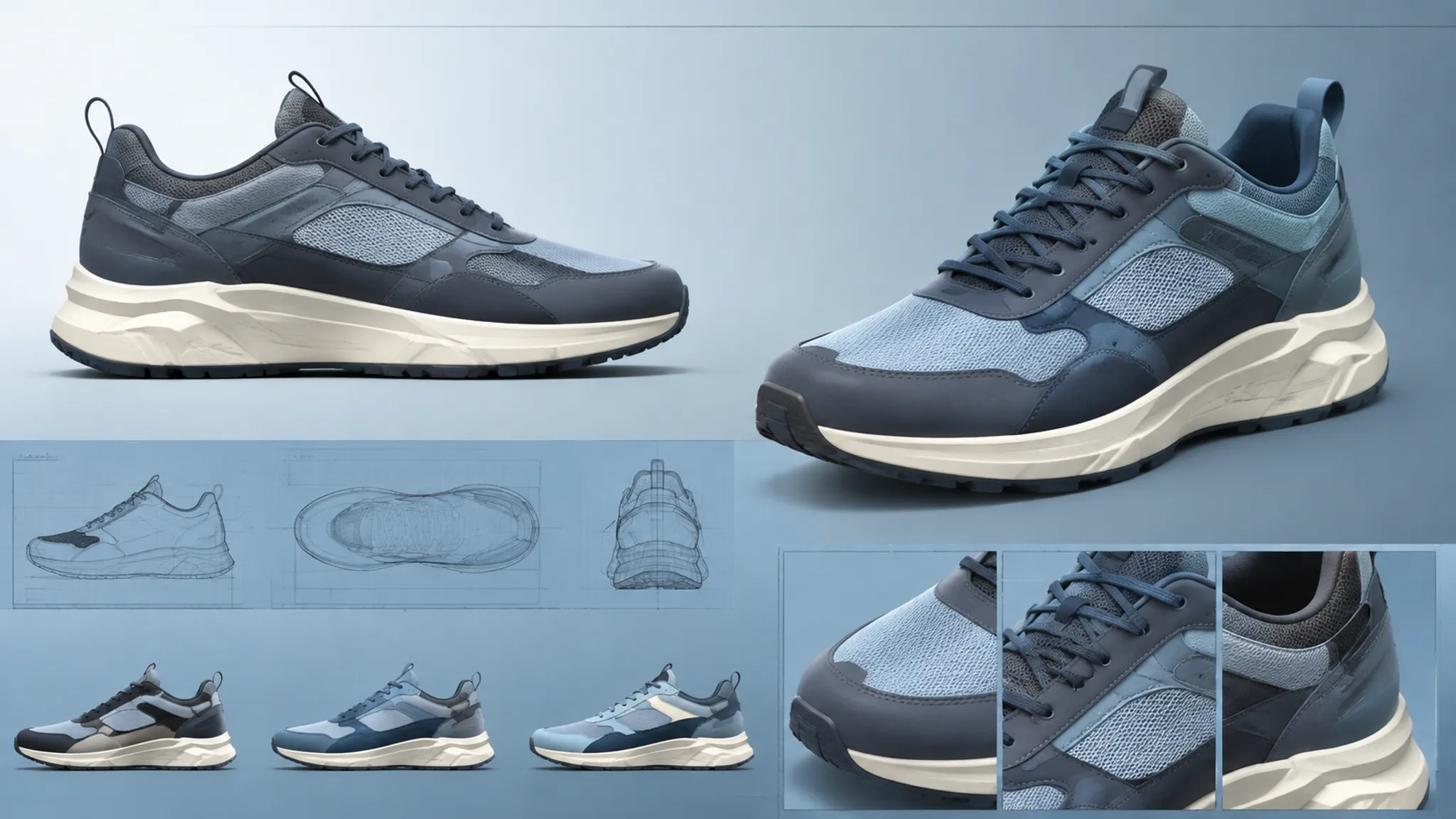
A side view may make the outer contour easy to compare while obscuring material transitions. A close study may reveal panel logic while removing the relationship between toe, waist, and heel.
Compare by visible delta
Taste-based rankings conceal the actual decision. Name what changes between directions:
- Direction A keeps the toe transition soft and continuous.
- Direction B introduces a sharper break through the forefoot overlay.
- Direction A carries one continuous side read.
- Direction B separates the upper zones more clearly at review scale.
Neither direction establishes how the parts would be constructed or behave in a sample. Those questions move to technical development after the visual choice is recorded.
Account for view-dependent conclusions
Camera position, lens, elevation, and crop can change apparent volume. Perspective may also make upper panels look wider or narrower than they do in a controlled comparison.
When viewing conditions differ, label the result as directional. A three-quarter image can suggest relationships among toe, quarter, and heel, but it is not interchangeable with a consistent side profile.
Review color as a relationship
Broad color names rarely capture what the image is doing. Lighting, surrounding tones, image treatment, and accent placement can all change the visual reading.
Inspect the dominant upper tone, secondary panels, accent placement, sole contrast, hardware or lace details, background influence, and highlight behavior. “Blue shoe” does not indicate whether blue belongs to the base material, heel overlay, small accent, or scene treatment.
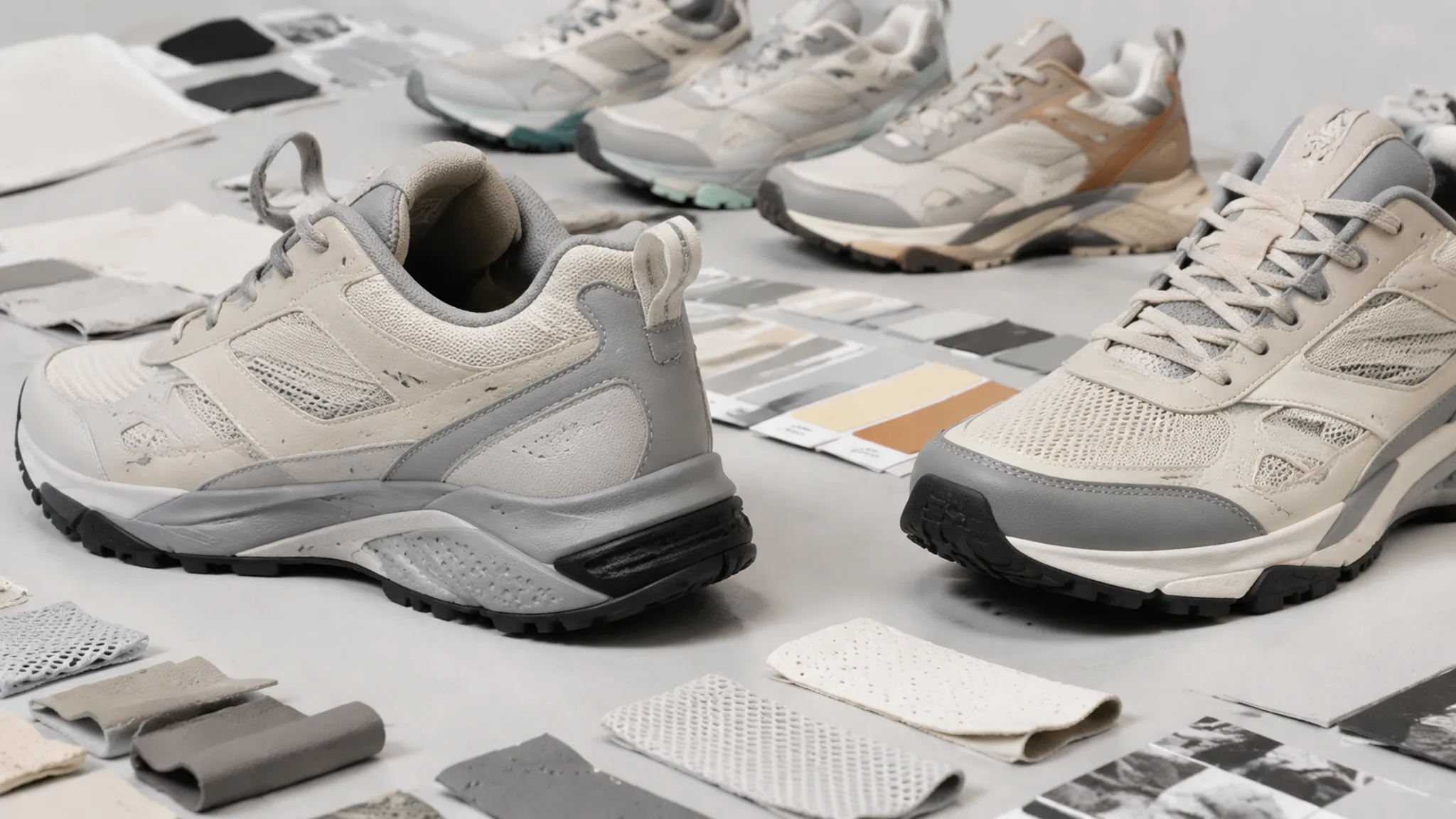
Relational notes are more useful:
- Warm off-white base with a cool gray heel zone.
- Dark outsole separates the pale upper from the background.
- Accent color appears only around the lace area and rear pull detail.
- Image lighting shifts the upper toward a warmer neutral.
- Color naming remains open pending material and color review.
Do not merge conflicting references too early
Two images may share a color label while showing different base tones, accent areas, sole relationships, or saturation. One label may describe the intended direction rather than the largest visible area.
Keep those references in separate variants until the conflict is understood. The appropriate correction may be a clearer role label, not deletion.
Match view coverage to the deliverable
More images do not guarantee better coverage. Several similar three-quarter views may still leave the medial side, heel, outsole, or collar relationship unseen.
Mark each required view as present, partial, or missing. The required coverage changes with the image’s job:
| Deliverable | Primary review criterion | Typical unresolved area |
|---|---|---|
| Moodboard | Coherent visual direction and interpretable reference roles | Complete product views |
| Material study | Close surface response and color relationships | Physical material behavior |
| Comparison view | Comparable framing, scale, and visible variables | Features outside the selected view |
| Collection variant sheet | Consistent display of fixed and changing elements | Undocumented construction differences |
| Campaign mockup | Framing, context, crop, and presentation hierarchy | Hidden construction and physical feasibility |
| Non-final turntable | Continuity across angles | Fit, movement, and material behavior |
A set may therefore support one concept decision while remaining incomplete for another. Approve the image for its stated job.
Control variant logic across the set
Variant logic states what changes and what remains fixed. Without that record, accidental presentation differences can appear to be intentional design choices.
For each variant, identify changes to the silhouette, upper zones, color placement, material cues, sole appearance, accessories, graphics, and camera conditions. Keep the view, crop, scale, background treatment, and naming structure as stable as the comparison requires.
If a colorway also changes camera angle and upper construction, reviewers cannot isolate which variable carries the concept. Separate the directions or label the combined change explicitly.
Presentation does not need to be identical across every exploratory image. It does need to reveal why the images are being compared.
Keep source records beside the images
A usable source record travels with the reference. It states what is known, what remains missing, and which sharing stage is being considered.
- Internal reference ID
- Source location or originating collection
- Capture or acquisition date, when known
- Creator or owner information, when known
- Intended use and review round
- Current rights-status note
- Location of available permission or license records
- Crops, edits, or transformations applied
- Associated concept or variant
- Open source or publication questions
A source location identifies where an image was found. It does not establish ownership, permission, license terms, or suitability for public presentation.
Use status labels that match the record
- Status documented: The available record describes the relevant usage basis.
- Status pending: Confirmation or further review is required.
- Source known, status unknown: The origin is recorded, but usage terms are missing.
- Internal source: The image comes from an internal workflow, with permissions recorded separately.
- Reference only: The image remains within internal discussion and is excluded from public presentation.
- Unknown: Both source and usage information are incomplete.
“Found online,” “provided by a collaborator,” and “used in an earlier deck” describe circumstances, not publication status. Route unresolved permission questions to the appropriate organizational or legal review.
Turn uncertainty into a correction route
A useful audit gives each unresolved issue a location, an owner, and a next action. “Needs cleanup” says too little. “The heel overlay changes between references, but the variant record does not identify that change” gives the team something inspectable.
| Observed issue | Correction route |
|---|---|
| Conflicting silhouette or visual direction | Return to concept design review |
| Missing construction detail | Move to design or engineering review |
| Uncertain material identity or appearance | Request material development or sampling |
| Fit, sizing, or shaping question | Use appropriate prototypes and fit review |
| Unknown source or incomplete permission record | Hold public use pending rights or publication review |
| Inconsistent crop, angle, or presentation | Return to visual QA |
Footwear-development research describes staged movement between virtual design, technical records, prototypes, conformity checks, and later review. That sequence supports one useful distinction: virtual review and physical approval are separate events, although the exact workflow varies by team.
Correct the library in reviewable passes

1. Remove decision noise
Separate direct comparisons from context references. Remove duplicates only when they add no distinct information, and retain exploratory images in a clearly labeled group.
2. Normalize comparison conditions
Align naming, crop, scale, and view labels where the decision requires consistency. Record edits, and do not conceal differences that affect the comparison.
3. Resolve visible conflicts
Compare silhouette, upper zoning, material cues, color relationships, and variant logic. If the images cannot resolve the conflict, keep both directions and state the open question.
4. Complete source records
Attach the available origin, creator, usage context, and status information. Mark missing fields as unknown or pending instead of filling them through inference.
5. Prepare the handoff
Record what has been accepted at concept level, what remains unresolved, and which review stage owns the next decision. The corrected set should clarify the next question without implying that later validation has occurred.
Common reference-set misreads
Similar images must have the same usage status
Visual-similarity analysis can describe shared composition, partial changes, area relationships, or design logic. It cannot determine ownership, permission, or publication conditions. Keep visual overlap notes separate from the rights record.
The main color is obvious from the render
A render may show a clear color relationship while leaving the intended label uncertain. Record both the visible arrangement and the team’s naming intent, then resolve any mismatch through color or material review.
A complete turntable settles the product decision
A turntable improves view coverage and may expose continuity problems between angles. Physical behavior, fit, construction, and performance still belong to samples and the relevant downstream process.
A source location completes the record
It records where an image was accessed. Creator information, ownership, permissions, license terms, edits, and intended use remain separate fields.
Pre-publication disposition
A reference set is ready to leave the working room when reviewers can identify each image’s purpose, compare the relevant views, distinguish fixed and changing variables, and locate every unresolved issue.
- Approve references that support the stated visual purpose.
- Revise unclear roles, conflicting variants, or inconsistent presentation.
- Request missing views, source details, or status records.
- Separate internal-only material from the public-facing set.
- Move construction, fit, material behavior, and performance questions to physical review.
- Hold publication where the intended use lacks sufficient documentation.
This framework is an editorial decision tool rather than a universal audit standard. The available research helps define visual similarity, color ambiguity, staged footwear development, and physical-validation boundaries; it does not settle ownership, licensing, or unrestricted public use for a particular image.